Cultivated Meat Workshop

Introduction & Framing · May 8, 2026

The Unjournal · Pivotal Questions Initiative

These slides are visual aids only — prepared from my notes.
The conversation is what matters.

Agenda · Resources · Beliefs Form

Watch pre-recorded intro (~18 min) →

A cultured meat figure at the opera, holding La Traviata

~10 min

David Reinstein

  • Economics researcher/professor, 20+ years (UK unis, Rethink Priorities)
  • Co-director, The Unjournal
I'm not a CM expert — please don't let me dominate the conversation.

The Unjournal (501(c)3 nonprofit)

"Commissioning public evaluation of research to make impactful research more rigorous — and vice versa"

  • 100+ evaluation packages across 53+ papers
  • Paid, transparent, citable reviews
  • Global priorities focus: animal welfare, AI safety, global health

info.unjournal.org →

The Pivotal Questions Initiative

"Which unanswered, quantifiable questions would most change what funders and advocates actually do?"

Frame as quantifiable, "operationalizable" Pivotal Questions
Evaluate evidence
Commission expert evaluation of relevant research
+
Elicit expert beliefs
Calibrated estimates on key uncertainties
Synthesize into actionable knowledge for decision-makers

info.unjournal.org/pivotal-questions.html →

Why Cultured Meat?

The case for attention

  • Potential to reduce animal suffering at enormous scaleWe recognize other potential benefits too — environmental impacts, and reduced zoonotic disease risk (animal-to-human pathogen spillover).
  • Transformative — "only if"Cost-competitiveness is necessary but not sufficient — customer acceptance, regulatory approval, and scale-up all matter too. We're focusing on the cost piece. cost-competitive
  • Animal welfare funders need clear-eyed cost projectionsAnd researchers and practitioners want to understand where to focus their efforts.

CM_01 — The focal question

"What will it cost to produce cultivated meatCost per kg of pure cell mass (wet weight), 2036 horizon. Note: the actual consumer product may be blended with plant-based ingredients — this question focuses on the cell biomass cost. at commercial scale?"
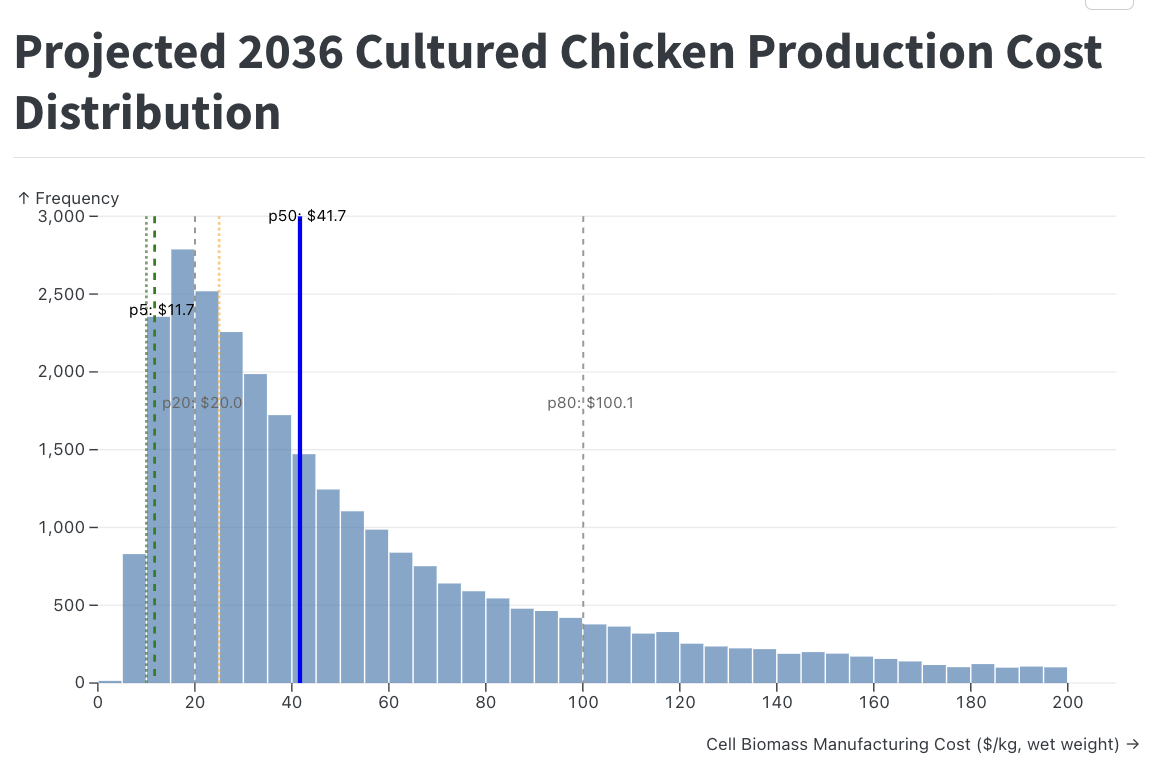
Projected 2036 CM production cost distribution — wide spread from under $20 to over $100/kg

Model output: projected 2036 cost distribution
(one set of assumptions — your estimates may differ substantially)

From Question to Workshop

Unit Cost = VOC + CAPEX/kg + Fixed OPEX/kg + Downstream/kg
1
TEA review → wide-ranging estimates; traced to a handful of key assumptions
2
Cruxes mapped: media costs, growth factors, bioreactor scale, cell density, process mode
3
First-pass modelReflects our current assumptions — deliberately simplified and not a finished product. Many parameters are placeholders awaiting expert input. Your input can help improve/reformulate it. — explicit cost structure, shared language and discussion framework
4
This workshop — real expertise and experience informing the assumptions, model structure, and focus; eliciting calibrated beliefs
5
Commissioned expert evaluationPart of The Unjournal's standard PQ process: paid, structured evaluations of the most relevant CM cost papers — quantitative ratings, public feedback, author response. Evaluators weigh in on the pivotal questions directly. This runs in parallel with the workshop and continues afterwards. — formal review of key CM cost research; experts weighing in on the pivotal questions. Ongoing.We're actively recruiting evaluators for the most relevant TEA papers. If you're interested in contributing an evaluation, or can suggest priority papers, let us know.

The Interactive Cost Model (WIP)

Cost breakdown by component — chosen parameters
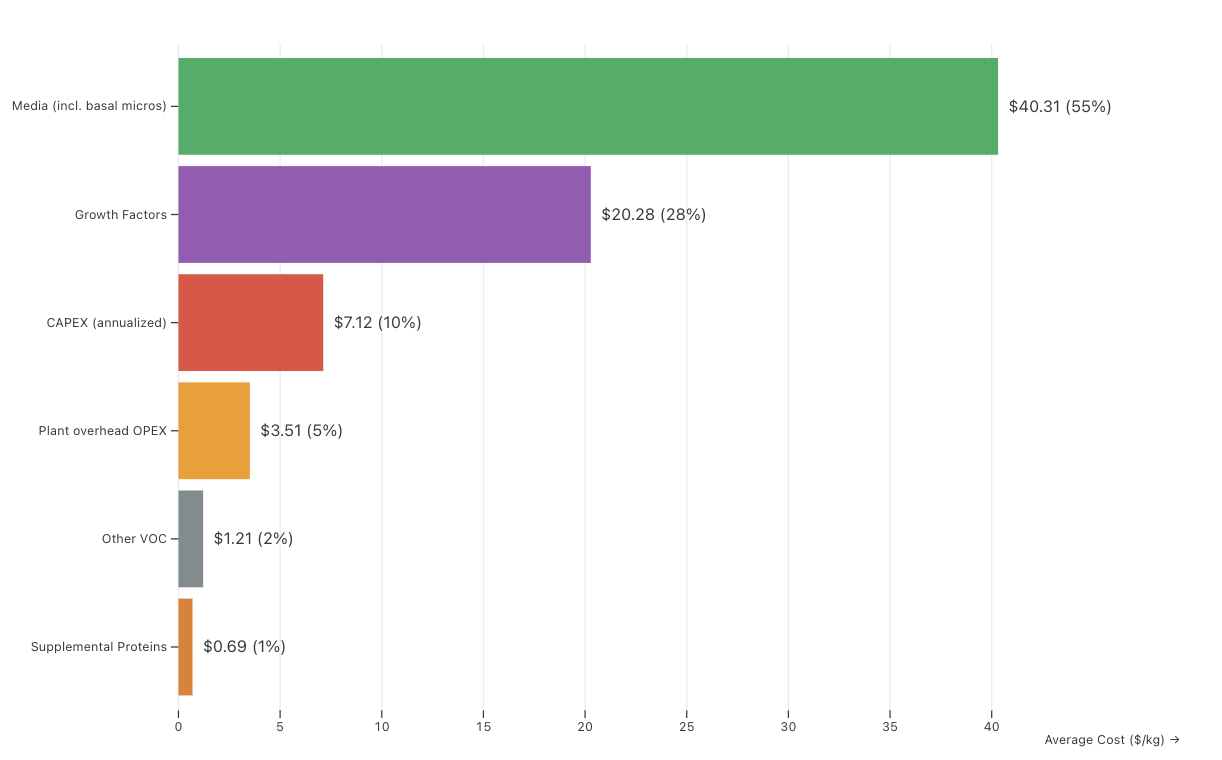
One possible scenario · Open model →

What it does

  • 30,000 Monte Carlo scenarios per run
  • Sliders: cell density, media cost ($/L), growth factors, bioreactor type, process mode, etc.
  • Outputs: cost distribution (p5/median/p95), component breakdown, sensitivity tornado
A reference and a WIP. Your input helps improve/reformulate it.We're proposing a follow-up model-building and robustness-checking "hacking workshop" — participants working directly on the model's structure, assumptions, and scope.

Explore the model; learn more about cultured meat

What We Want to Achieve

1
Frontier synthesis : pool researchers, practitioners, and forecasters; reach the collective frontier of what's known
2
Common language : shared definitions and scopee.g. "cost per kg" — of what exactly? Pure cell mass? Retail-equivalent? Including CAPEX? At what scale?. "Cost per kg": of what, at what scale, including what?
3
Map disagreements : where & why do optimists and skeptics diverge? Find the cruxesA crux: a point of disagreement whose resolution would most shift your conclusion — the highest-value thing to investigate
4
Elicit expert beliefs : calibrated estimates'More calibrated': stated confidence comes closer to realized outcomes. E.g., things you state are 70% likely to happen close to 70% of the time. on specific questions; crucial inputs for forecasters and funders
5
Build collaboration tools : how can researchers, practitioners, and forecasters best work together to refine our understanding of challenging, high-impact quantitative questions?

The Belief ElicitationCapturing knowledge and beliefs with calibrated uncertainty — structured to observe how discussion and evidence shift expert views over time.

We observe beliefs at three points:

Before
Estimate before hearing others
During/After
Adjust, considering discussion and new info
Later
See others' responses; update
Attributed or anonymous — your choice.
Go to beliefs form →
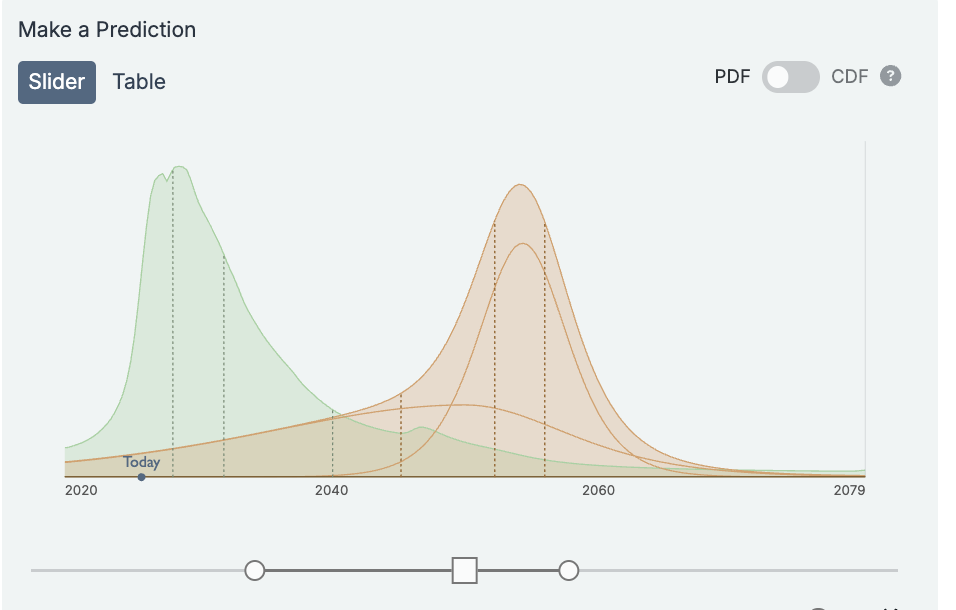
Metaculus prediction interface showing two very different forecaster distributions

Forecast the 2036 CM cost on Metaculus here

The Questions

Give your median estimate + 80% credible interval for each.

CM_01 — What will it cost to produce cultivated chicken at commercial scale by 2036? Cost per kg, pure cell mass (wet weight) — the central question
CM_12 — Will most CM use hydrolysatesProtein hydrolysates as amino acid source — cheaper but less defined than purified amino acids for media by 2036?
CM_14 — Cell media cost per kg CM output in 2036?
CM_16 — Achievable cell density in a 20,000-L bioreactor by 2036?
CM_10 — Does $100k to CM development beat $100k to corporate AW campaignse.g. cage-free commitments — a well-documented benchmark for animal welfare funding for animal welfare?

Attributed or anonymous — your choice. · Beliefs form →

Today's Structure

Session 1
11:00–12:10 ET
Public · Recorded
Technical Foundations
  • This intro (11:00–11:15)
  • Oana Kubinyecz — gene editing
  • Aleksandra Fuchs — hydrolysates
  • Six structured topics
Session 2
12:25–13:35 ET
Internal · ConfidentialPlease do not share S2 discussions externally without explicit approval. Note for industry participants: you don't need to share proprietary data or trade secrets. But flagging a discrepancy — even just "this doesn't match what we see in practice" — is highly valuable, even without specifics. You can also flag things anonymously or message David directly.
Scale-up & Industry Realities
  • TEA vs. operator experience
  • Real cost benchmarks
  • CDMO economics
Session 3
13:50–15:00 ET
Off-record → Public
Synthesis & Next Steps
  • 13:50–14:35: Off-record — open discussion, what didn't get aired
  • 14:35–15:00: Public/recorded — synthesis, AW funding, UJ priorities
S1 & 2nd part of S3: public, recorded. S2, S3 part 1: internal — please don't share further w/o approval.
Zoom chat: immediate corrections, issues, signal-boosts · Hypothes.is: quick demo — get a free account at hypothes.is now; annotate 'discussion' sections, now and afterwardsWe want the discussion to continue well beyond today. Hypothes.is lets you annotate specific sections inline. There's also a structured GitHub Discussions space — github.com/unjournal/cm_pq_modeling/discussions — and we'll try to integrate these into a coherent ongoing conversation.

Full agenda → · Resources → · Zoom setup →

Good Epistemic Environment

Deeply collaborative and friendly — with a few tools to help us stay honest

collaborative · curious · cooperative

Scout mindsetSeeking what's true, not defending a position. Julia Galef's framing: soldier vs. scout.: pursuing truth, not defending a position
Calibrated uncertainty: distinguish knowing from estimating
Steel-manRepresent opposing views in their strongest, most charitable form before critiquing: represent opposing views at their strongest
Track the crux: what evidence would most change your mind?
Reasoning transparency: explain the basis, not just the conclusion
Modesty: know your own limits
"What evidence could change my mind?"

Let's Begin

→ Quick Hypothes.is demo · then Oana Kubinyecz: Gene Editing in Cultured Meat (11:15)

Questions or clarifications on anything here? Happy to revisit during the break.

Agenda · Resources · Beliefs Form · Cost Model · Hypothes.is

Speaker script ↓

script